

Software Change Audits: Evidence That Matters Beyond a Certification Badge
Introduction
A certification badge is a useful first signal. It suggests that an organisation has defined processes and undergone an external assessment. But it does not show what happened when a particular change moved from a developer’s workstation into production.
That distinction matters. A software change audit examines whether controls worked for the release under review, not how polished the organisation’s policies look. The key question is whether the evidence shows how a specific change was requested, assessed, approved, tested and deployed.
An audit is decided by the sequence of events, not the team sheet. A certificate may indicate the organisation’s general standing. The decisive evidence connects a real change to the people, decisions and technical events that carried it through.
Analysis of the teams and players
The first side is the delivery team: engineers, reviewers, test specialists and release owners. Their work creates the primary evidence trail. A change request or ticket should explain the purpose and expected impact. Version-control history should show what changed, and review records should identify who examined the work and what they concluded.
These records are strongest when they are connected. A ticket linked to a code change, a review attached to that change and test results from the same version form a coherent account. Separate screenshots and policy documents may be genuine, but they may not show that the records refer to the same release.
The second side is the control environment: security, compliance, platform and operations teams. They define rules for access, separation of duties, testing and deployment. Their job is not just to publish those rules, but to apply them in the workflow through enforced permissions, recorded approvals, reliable test results and deployment logs with identifiable owners.
Independent reviewers, whether from internal audit or an external assessor, should test the account rather than accept its neatest presentation. They can trace selected changes across systems, check timestamps and identities, and ask what happened when the process deviated from its usual route.
No single player can provide the whole story. A developer can explain the intent but may not control production access. A manager can approve a release but may not know whether the tested build was the one deployed. Reliable assurance comes from evidence that corroborates across roles and systems.
Key factors
Traceability is the starting point. Each change should have a durable identifier that lets an auditor follow it from request to implementation and release. If links between tickets, code commits, build records and deployment events are missing, the audit becomes a reconstruction exercise based on memory and interpretation.
Approval must be meaningful. A recorded click does not necessarily prove an informed review. The record should identify the approver, show when approval occurred and make clear what was approved. If approval came after deployment, or the approver also made the change without an effective compensating control, the timeline deserves closer scrutiny.
Testing needs context. A green test result is useful only when it is tied to the code version and build being released. Auditors should check which tests were required for that type of change, their outcomes, and whether any tests failed or were skipped. A complete record that explains exceptions is more persuasive than a clean summary that omits them.
Deployment records close the loop. The audit trail should show what entered the target environment, when it happened and which person or automated process carried it out. Comparing the deployed artifact with the tested one helps establish that the release did not change between verification and deployment.
Access and exceptions reveal pressure points. Emergency fixes, privileged accounts and manual interventions are not necessarily failures. They become risks when access is shared, activity cannot be attributed, or exceptions lack a documented reason and follow-up review. A mature process can accommodate urgency while recording who acted and why.
Evidence quality matters more than volume. Hundreds of logs do not build confidence if their source is uncertain or retention is inconsistent. Useful evidence is attributable, time-stamped, protected from casual alteration and kept long enough for review. The organisation should also explain how automated records are generated and what their limitations are.
Sampling should reflect risk. A routine, low-impact update and a change to a sensitive production service do not need identical scrutiny. Auditors should understand the organisation’s risk categories and check whether the level of review and control matched each change’s potential impact.
Match scenario
Consider a production release that fixes a defect shortly before a planned deployment window. The certificate says the organisation has a change-management framework. The audit starts with the defect record: what was broken, how urgent the fix was and which systems might be affected.
It then follows the change through the process. The auditor checks the code history, reviewer identity, test results for the relevant build, approval timing and deployment record. If the standard approval route was bypassed, the record should explain why, who authorised the exception and what review followed.
Now imagine the records disagree. The ticket describes one fix, the test report refers to a different build, and the deployment log names a privileged account rather than a release owner. None of these discrepancies proves misconduct on its own. Together, though, they make it harder to establish what was released and whether the intended controls worked.
A strong audit may also show that the process held up under pressure. For example, it may confirm that an emergency route was authorised, the change was appropriately tested, deployment was limited to the required system and an independent review followed. The distinction is not between routine and urgent work, but between controlled exceptions and undocumented improvisation.
Conclusion
Certification is a useful broad signal, but it cannot replace evidence about a particular software change. It does not show whether a specific approval was timely, whether tests covered the deployed build or whether production access was properly controlled.
The strongest audit tells a connected story: a defined request, an attributable change, meaningful review, relevant testing, controlled deployment and a documented response to exceptions. When records agree across systems, assurance becomes more than a claim. When they do not, the gaps show where the process needs attention.
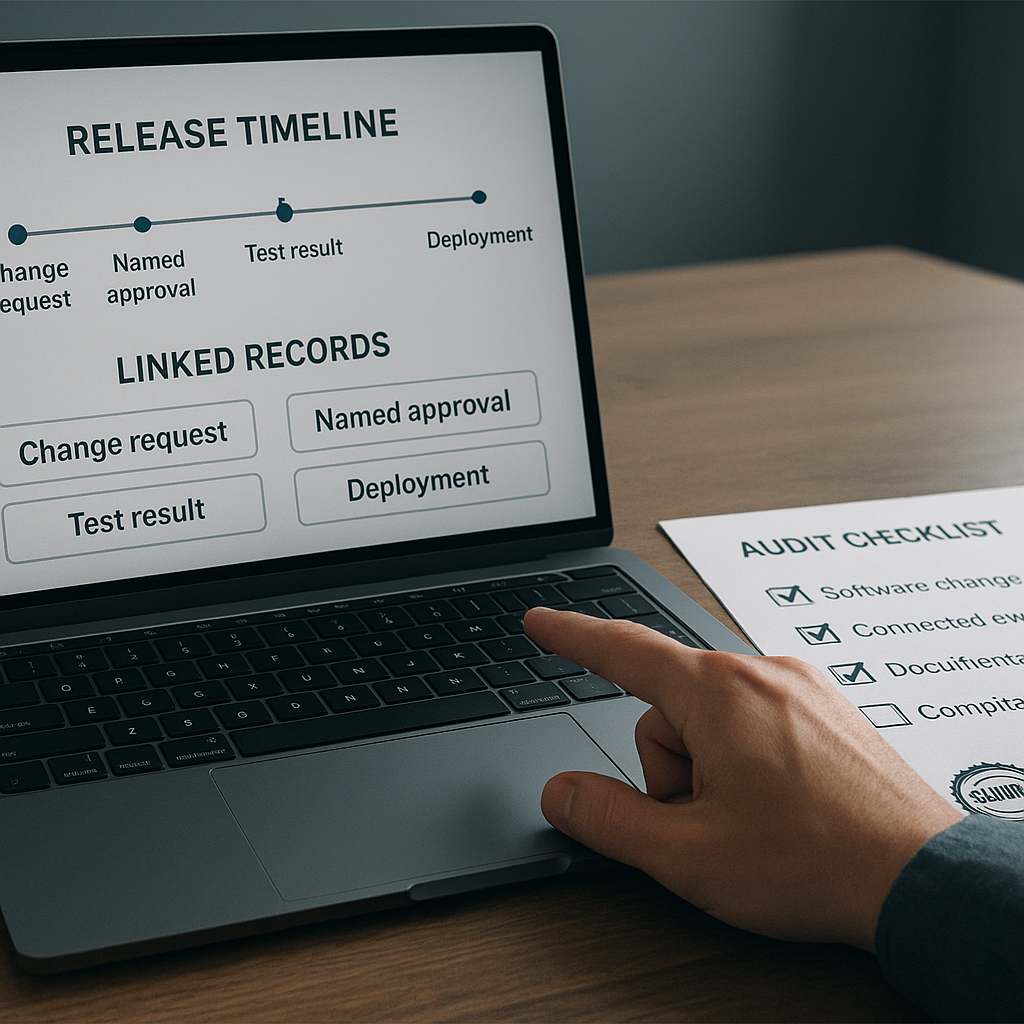
The badge is the pre-match briefing. The evidence is the performance: the sequence of decisions, checks and actions that shows whether the organisation’s controls held when the change mattered.